



Passing the 18th Edition exam requires more than simply reading through the regulations book from beginning to end. The most effective preparation combines understanding the structure of BS 7671, learning how to find information quickly, practising exam-style questions and becoming comfortable using the regulations during an assessment.
Whether you are completely new to the 18th Edition or returning to revise before your exam, having a structured study plan can make the process much easier.
What Is the 18th Edition?
The 18th Edition refers to the IET Wiring Regulations, BS 7671. It provides the requirements for the design, installation, inspection and verification of electrical installations.
For electricians and electrical students, understanding BS 7671 is an important part of developing safe and compliant installation practices.
The regulations cover a wide range of subjects, including protection against electric shock, protection against overcurrent, earthing and bonding, cable selection, isolation and switching, inspection and testing, special installations and locations, and many other aspects of electrical installation work.
The amount of information can initially seem overwhelming. However, you are not expected to memorise every regulation. One of the most important skills is learning how to navigate the book efficiently.
Don’t Try to Memorise the Whole Book
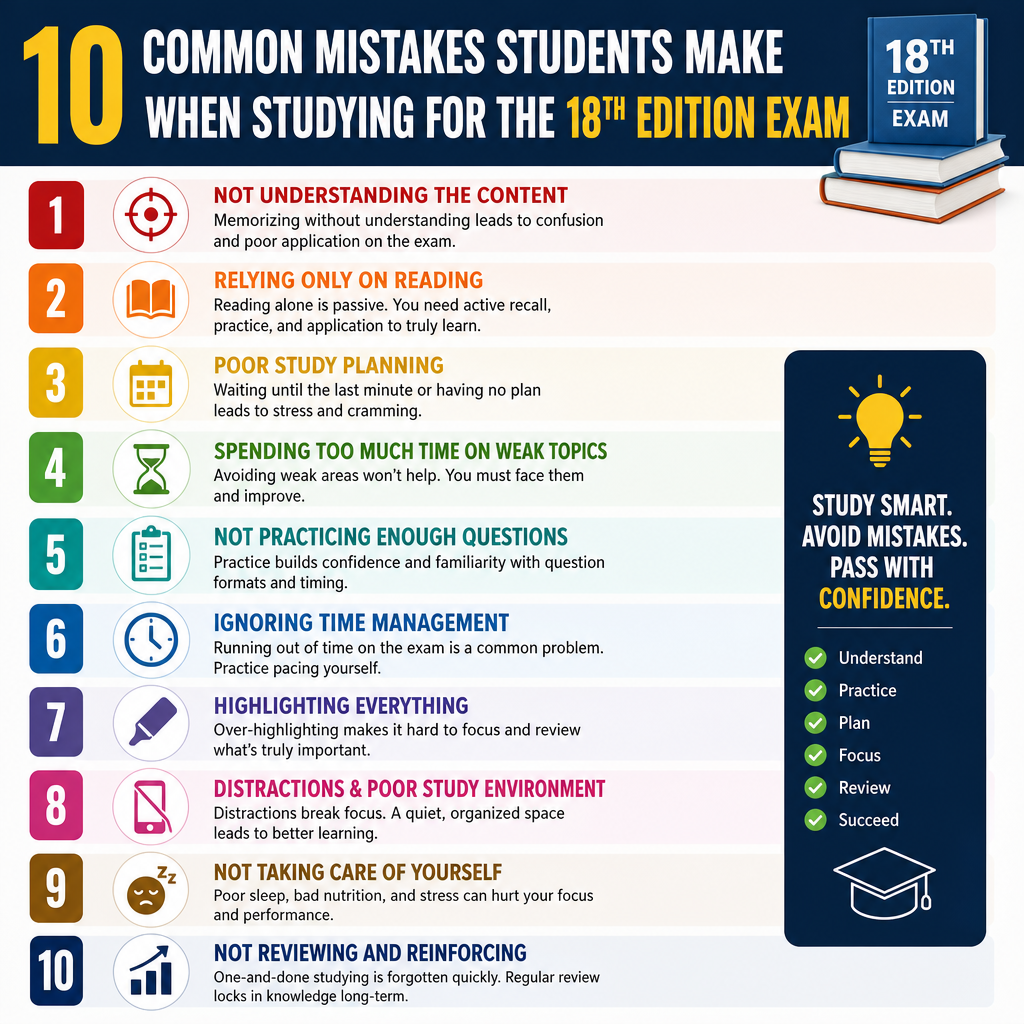
One of the biggest mistakes students make is attempting to memorise hundreds of regulations, tables and numbers.
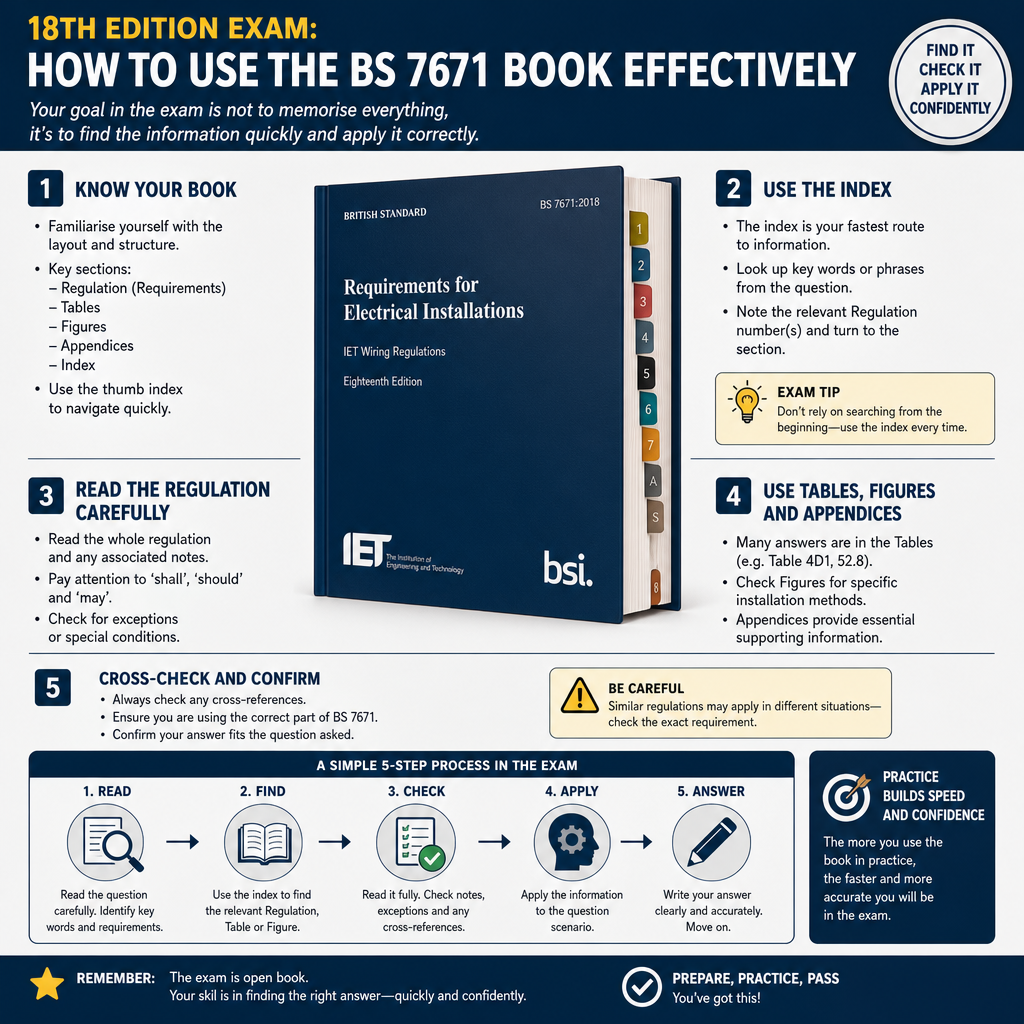
BS 7671 is designed as a reference document. Your goal should be to understand where information is located and how different sections of the regulations relate to one another.
For example, if a question concerns protection against electric shock, you should recognise that the answer is likely to be found within the relevant section of Chapter 41.
If the question concerns cable current-carrying capacity, you should know that the relevant information can be found in the appropriate tables and associated guidance.
This approach is much more practical than trying to memorise the entire book.
Learn How to Use the Index
The index is one of the most useful tools in the regulations book.
During your revision, practise looking up subjects rather than immediately searching for regulation numbers.
For example, if you encounter a question about voltage drop, use the index to locate the relevant information. Then read the regulation and any associated tables or notes.
Repeat this process with different subjects.
Over time, you will become faster at locating information. This is particularly useful when working through practice questions.
Understand the Structure of BS 7671
Before attempting hundreds of questions, spend some time becoming familiar with the structure of the regulations.
Learn what the major parts, chapters and sections cover.
You do not need to memorise every regulation number. Instead, develop a general mental map of the book.
For example, you should become familiar with areas such as:
- Fundamental principles
- Protection for safety
- Selection and erection of equipment
- Inspection and testing
- Special installations and locations
- Appendices
- Tables and reference information
Once you understand the organisation of the book, finding information becomes considerably easier.
Practise With Exam-Style Questions
Reading the regulations is important, but reading alone is not enough.
You need to practise answering questions.
Question banks and mock exams allow you to identify areas where your knowledge is strong and subjects that require further revision.
When you answer a question incorrectly, don’t simply look at the correct answer and move on.
Instead, find the relevant regulation in BS 7671 and read the surrounding information.
Ask yourself:
Why was my answer wrong?
Where did the correct answer come from?
Could I find this information again without being shown the regulation?
This turns every incorrect answer into a revision opportunity.
Keep a Record of Your Mistakes
One of the most effective revision techniques is keeping track of questions you repeatedly get wrong.
Create a list of subjects that require additional attention.
For example:
Weak areas
- Earthing arrangements
- Maximum disconnection times
- Cable selection
- Voltage drop
- Protective devices
- Special locations
- Inspection and testing
You can then concentrate your study time on these areas instead of repeatedly revising subjects you already understand.
Use Mock Tests Properly
Mock tests are most useful when you treat them as a way of measuring your preparation rather than simply trying to achieve a high score.
At the beginning of your revision, your score may be relatively low. That is normal.
The important information is what the result tells you.
If you consistently struggle with a particular topic, return to that section of BS 7671 and study it again.
As your knowledge improves, repeat the mock test and compare your results.
You should eventually aim to achieve consistently strong scores rather than relying on one successful attempt.
Practise Working Under Time Pressure
Knowing the answer is only part of the challenge. You also need to be able to locate information efficiently.
When practising, start without worrying too much about time.
Once you become comfortable with the questions, begin introducing time limits.
This helps develop the ability to read a question, identify what it is asking, locate the relevant information and select the correct answer efficiently.
Don’t spend too long on one difficult question. If necessary, move on and return to it later.
Understand the Question
Exam questions can sometimes be challenging because of the way they are worded.
Read the entire question carefully before looking at the possible answers.
Pay particular attention to words such as:
- Maximum
- Minimum
- Required
- Permitted
- Must
- Should
- Except
- Not
A single word can change what the question is asking.
Avoid choosing an answer simply because it looks familiar. Always make sure it actually answers the question being asked.
Don’t Ignore Tables and Appendices
Students sometimes concentrate heavily on the main regulations and overlook the appendices and tables.
This can be a mistake.
Tables contain important technical information, while appendices provide useful reference material.
During your revision, practise locating tables and understanding what information they provide.
Don’t just memorise a table. Understand what it is used for and when you would need to refer to it.
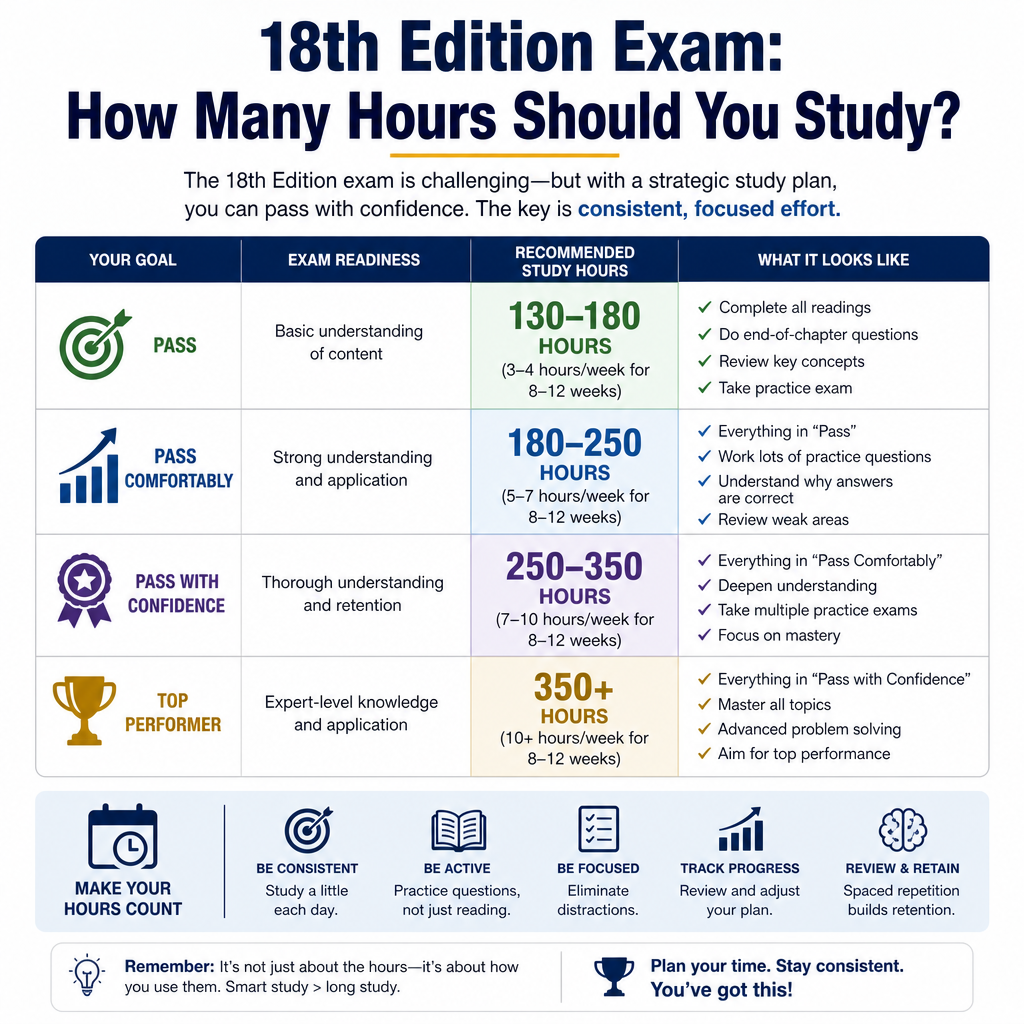
Create a Realistic Study Routine
You don’t necessarily need to study for several hours every day.
Consistent revision is generally more useful than occasional long sessions.
For example, a study session could include:
30 minutes: Read a section of BS 7671.
30 minutes: Work through related questions.
20 minutes: Review incorrect answers.
20 minutes: Practise locating regulations and tables.
You can adjust the times depending on your schedule.
The important thing is to make your study routine sustainable.
A Simple 30-Day Study Approach
If you have around one month to prepare, you could divide your revision into four stages.
Week 1 — Understand the Book
Become familiar with the structure of BS 7671, the index, chapters, sections, tables and appendices.
Week 2 — Study Key Subjects
Work through the major areas of the regulations and complete practice questions relating to each subject.
Week 3 — Identify Weak Areas
Complete larger question sets and mock exams. Record your mistakes and concentrate on the areas where your scores are weakest.
Week 4 — Exam Preparation
Complete full mock exams under timed conditions. Review incorrect answers and practise finding information quickly in BS 7671.
What Should You Do When You Get a Question Wrong?
Getting a question wrong isn’t wasted time.
In fact, incorrect answers can be some of the most useful parts of your revision.
Instead of memorising the correct answer, investigate why it is correct.
Find the regulation.
Read the relevant section.
Check any associated tables or notes.
Then try another question covering the same subject.
This process helps turn a mistake into knowledge that you can use again.
When Are You Ready for the Exam?
There is no single mock-test score that can guarantee that you will pass the real examination.
However, consistently achieving strong results across different practice tests is a much better indication of preparation than achieving a high score once.
You should also be comfortable navigating BS 7671 and finding information without relying entirely on memory.
Before booking or sitting your exam, make sure you understand the current examination requirements and the materials you are permitted to use.
Final Revision Tips
As your exam approaches, concentrate on your weaker areas rather than attempting to learn everything again.
Practise using the index.
Review regulations that you frequently get wrong.
Complete realistic mock exams.
Work on your timing.
Read questions carefully.
Most importantly, learn how to use BS 7671 as a reference document.
The objective isn’t to memorise an entire book. It is to develop the knowledge and skills required to understand electrical regulations and locate the information you need efficiently.
Start Your 18th Edition Revision
Preparing for the 18th Edition becomes much more manageable when you combine the regulations book with regular practice questions and realistic mock exams.
At Electrician Mock Test, you can use online practice questions and mock tests to test your knowledge, identify weaker areas and build confidence as your exam approaches.
The more you practise finding information, understanding questions and applying the regulations, the more prepared you will be for the real assessment.
Leave a Reply