



Preparing for the 18th Edition exam is not simply about spending as many hours as possible reading BS 7671. The quality and consistency of your revision are usually more important than the number of hours you sit at a desk.
Some students may need several weeks of preparation, while others with previous electrical experience may require less. The right amount of study depends on your existing knowledge, familiarity with BS 7671 and how confidently you can answer exam-style questions.
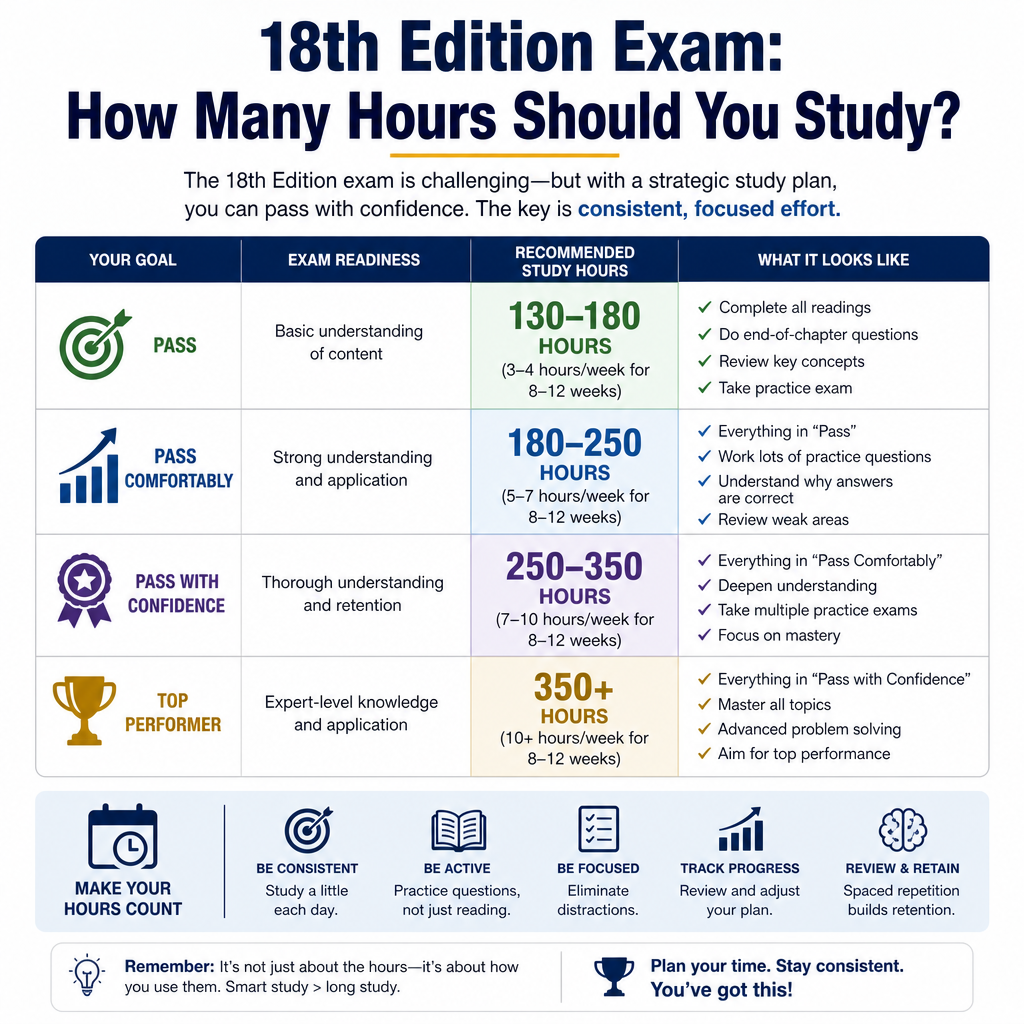
How Much Study Time Do You Need?
There is no single number of hours that guarantees a pass.
Someone who already works in the electrical industry may be familiar with many of the concepts covered by the regulations. Someone newer to electrical installation may need considerably more time to understand the terminology and principles.
A useful starting point is to study consistently rather than attempting to complete large amounts of revision at the last minute.
For example, studying for 1–2 hours several times a week can be more manageable than trying to complete an entire weekend of intensive revision.
Quality Matters More Than Quantity
Spending four hours reading BS 7671 doesn’t necessarily mean you have completed four hours of effective revision.
If you are reading without testing yourself, you may not remember much of the information later.
A more effective study session could combine different activities:
30 minutes reading a section of BS 7671.
30 minutes answering questions about that subject.
20 minutes reviewing incorrect answers.
20 minutes practising finding relevant regulations.
This gives you a mixture of reading, recall, problem-solving and practical use of the regulations.
Start by Assessing Your Knowledge
Before creating a detailed study timetable, find out what you already know.
Try an initial set of practice questions without spending days revising beforehand.
Your score can provide a useful starting point.
More importantly, look at which subjects caused problems.
For example, you may perform well with general electrical principles but struggle with:
- Cable selection
- Voltage drop
- Earthing
- Disconnection times
- Protective devices
- Special locations
- Inspection and testing
These areas should then receive more attention during your revision.
Don’t Study Everything Equally
Your revision time should reflect your strengths and weaknesses.
If you consistently answer questions correctly about a particular subject, you probably don’t need to spend hours repeatedly studying it.
Instead, concentrate on areas where you are making mistakes.
This makes your revision more efficient.
Keep a simple record of your practice results and look for patterns over several tests rather than judging your preparation from one result.
A Four-Week Study Plan
If you have approximately four weeks before your exam, you can divide your preparation into stages.
Week One: Learn the Structure
Spend the first week becoming familiar with BS 7671.
Look through the contents pages, chapters, sections, tables and appendices.
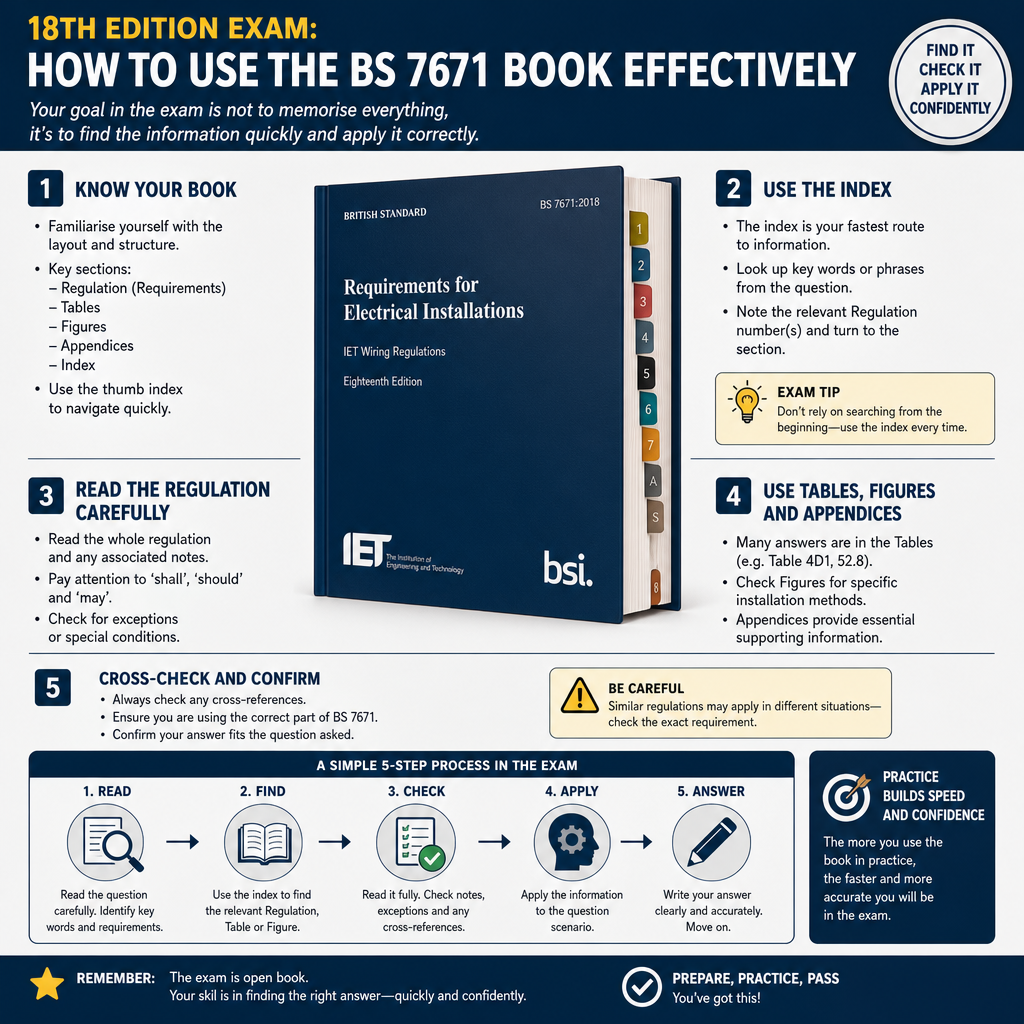
Practise using the index.
The objective is to understand where information is located.
Week Two: Study the Main Subjects
Start working through the major areas of the regulations.
After studying each subject, complete related practice questions.
Don’t simply record your score.
Review your incorrect answers and find the relevant information in the book.
Week Three: Focus on Weak Areas
By this point, you should have identified subjects that require additional revision.
Concentrate on these areas.
Complete different question sets rather than repeatedly answering questions you have already seen.
Try to understand why an answer is correct rather than simply remembering it.
Week Four: Mock Exams
Use the final week to increase the amount of timed practice.
Complete full mock tests and review your results carefully.
Practise finding information quickly in BS 7671.
Your goal is to become comfortable with both the questions and the process of navigating the regulations.
Short Study Sessions Can Be Effective
You don’t always need a long study session.
If you only have 30 minutes available, use it effectively.
You could spend 10 minutes reviewing a regulation, 10 minutes answering questions and 10 minutes checking your mistakes.
Regular short sessions can help keep information fresh.
The important factor is consistency.
Avoid Last-Minute Cramming
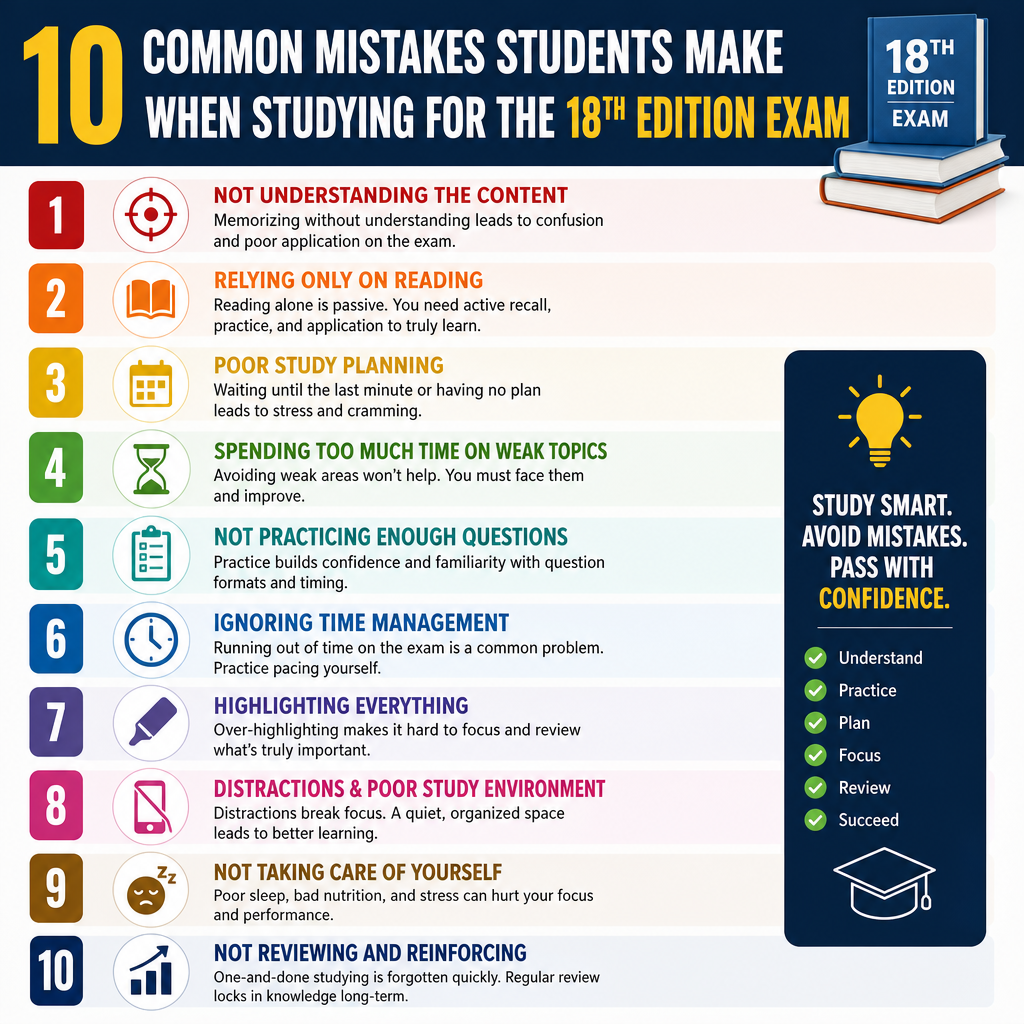
Trying to learn large amounts of information immediately before the exam can be stressful and ineffective.
Your brain needs time to process and recall information.
Regular revision gives you opportunities to revisit difficult subjects several times.
If you study something today and return to it several days later, you can test whether you actually remember it rather than simply recognising it from the previous session.
Use Active Revision
Active revision means doing something with the information rather than simply reading it.
Examples include:
- Answering questions
- Finding regulations
- Explaining a subject in your own words
- Reviewing mistakes
- Completing mock exams
- Testing yourself without looking at the answer
These activities require you to recall and apply information.
That makes them particularly useful when preparing for an exam.
What If You Are Struggling?
If your scores aren’t improving, don’t automatically increase your study hours.
First, identify the problem.
Are you struggling to understand the subject?
Are you unable to find the relevant regulation?
Are you misreading the questions?
Are you running out of time?
Are you repeatedly making the same type of mistake?
The solution depends on the problem.
For example, if you understand the subject but can’t find the relevant information, you need to practise navigating BS 7671 rather than simply reading it again.
How Do You Know When You’re Ready?
A single high mock-test score doesn’t necessarily mean you’re ready.
Look for consistent performance across different practice tests.
You should also be comfortable using BS 7671 and locating information without excessive hesitation.
If you repeatedly achieve strong results and can explain your answers rather than simply remembering them, your preparation is likely progressing well.
Remember that practice-test performance cannot guarantee a particular result in the real examination.
Create a Study Routine That You Can Maintain
The best study plan is one you can actually follow.
You might study for an hour after work, spend a longer session at the weekend and complete short question sessions during spare time.
There is no requirement for every study session to be identical.
The objective is to create regular opportunities to learn, practise and review.
Final Thoughts
There is no magic number of study hours required to pass the 18th Edition exam.
Your required preparation time depends on your existing knowledge, experience and familiarity with BS 7671.
Rather than focusing entirely on the number of hours, concentrate on what you achieve during those hours.
Study the regulations, practise using the book, complete exam-style questions, review your mistakes and regularly test yourself with mock exams.
A consistent approach is far more useful than leaving everything until the final few days.
Electrician Mock Test provides online practice questions and mock exams to help you measure your knowledge, identify areas for improvement and make your revision more focused.
Leave a Reply