



The 18th Edition exam is not simply about remembering large amounts of information. One of the most important skills you can develop is knowing how to use BS 7671 efficiently.
The regulations book contains a considerable amount of technical information, including regulations, tables, diagrams, definitions and appendices. Trying to memorise everything would be unrealistic. Instead, your preparation should focus on understanding the structure of the book and becoming confident at finding the information you need.
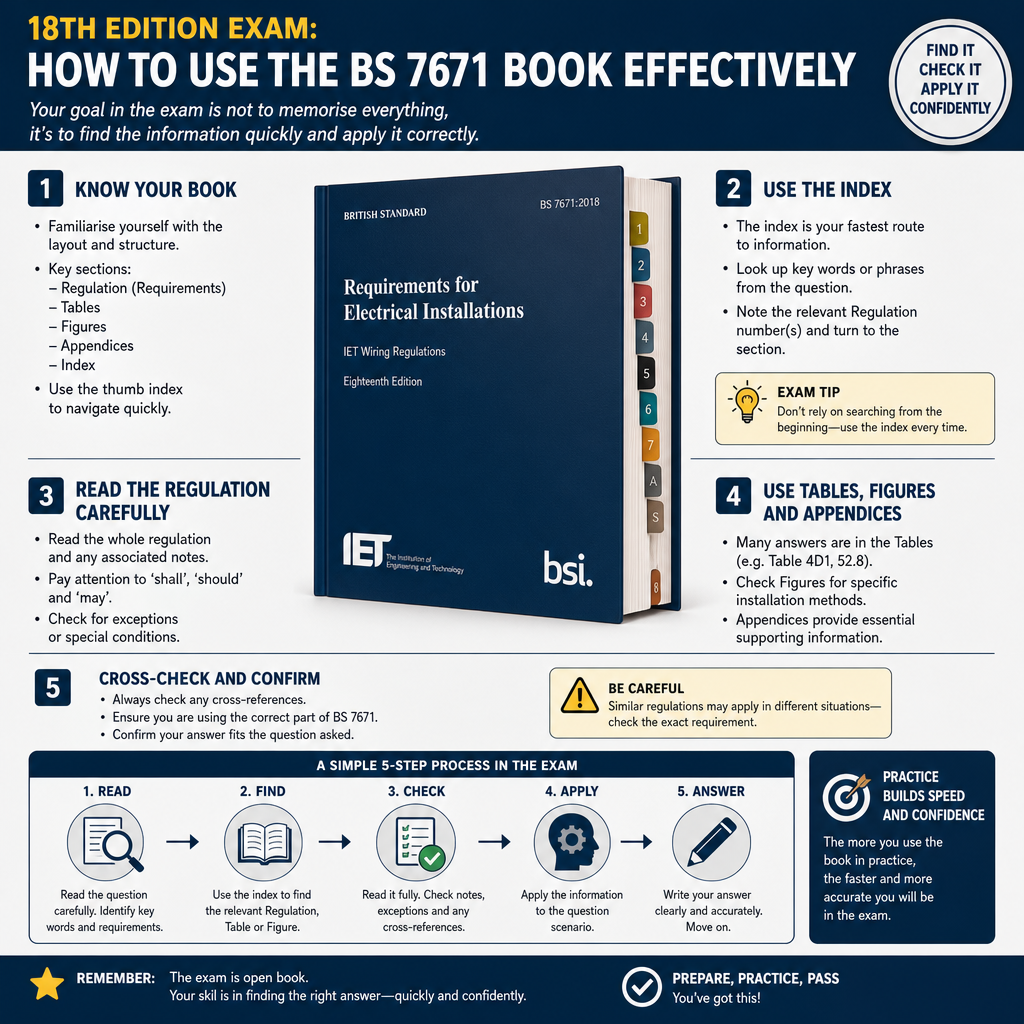
Get Familiar With the Book
Before starting intensive revision, spend some time simply getting familiar with BS 7671.
Look through the contents pages and identify the main sections. Learn where the major subjects are located and become comfortable moving between chapters, sections, regulations, tables and appendices.
You don’t need to memorise every regulation number.
The objective is to develop a general understanding of where different types of information can be found.
Over time, this will make your revision much more efficient.
Learn to Use the Index
The index is one of the most valuable tools in BS 7671.
If you are unsure where information is located, start with the subject you are looking for and use the index to identify the relevant regulation or section.
For example, you may need information about voltage drop, earthing, bonding, protective devices or disconnection times.
Rather than guessing where the information is located, use the index to guide you.
Practise doing this regularly during your revision.
The more you use the index, the quicker you will become.
Don’t Just Look at the Regulation Number
Finding a regulation number is only the beginning.
Once you locate the relevant regulation, read the surrounding information carefully.
Pay attention to:
- Definitions
- Notes
- Tables
- Diagrams
- Exceptions
- Additional requirements
- Referenced regulations
A question may require you to combine information from more than one part of BS 7671.
Reading only one sentence and immediately choosing an answer can lead to mistakes.
Understand the Numbering System
The numbering system in BS 7671 can initially appear complicated, but it becomes easier once you understand how it is organised.
Regulations are grouped into chapters, sections and regulation numbers.
You should become familiar with the general structure rather than trying to memorise every number.
For example, knowing that a particular subject belongs within a particular chapter gives you a starting point when searching for an answer.
This is especially useful when practising questions because you gradually develop a mental map of the regulations.
Tables Are Extremely Important
Tables contain some of the most useful technical information in BS 7671.
However, you should avoid trying to memorise every table.
Instead, learn what different tables are used for and practise locating them.
When working through practice questions, deliberately use the book rather than relying on memory.
For example, if a question requires technical information from a table, find the table and check the answer.
This develops the same research skill you will need when dealing with electrical regulations in practice.
Use Practice Questions Alongside the Book
One of the most effective ways to learn BS 7671 is to combine reading with questions.
Read a section of the regulations and then complete questions relating to that subject.
If you get a question wrong, return to the book.
Find the relevant regulation and work out why your answer was incorrect.
This creates a useful cycle:
Study → Question → Check → Find Regulation → Understand → Practise Again
Repeatedly using this process will gradually improve both your knowledge and your ability to navigate the book.
Don’t Rely Completely on Memory
There are certain regulations, values and principles that you will naturally remember through repeated study.
However, you shouldn’t assume that memorising everything is the best strategy.
Electrical regulations contain a large amount of detailed information.
A better approach is to understand the principles and know how to locate supporting information when you need it.
Think of BS 7671 as a technical reference book rather than a textbook that must be memorised from cover to cover.
Practise Finding Information Quickly
Once you become comfortable with the book, start timing yourself.
Choose a subject and see how quickly you can locate the relevant information.
For example:
Subject: Voltage drop
Task: Locate the relevant regulation.
Then repeat the exercise with other subjects.
You can gradually make the exercises more difficult by starting with a question rather than a subject.
Read the question, identify what information you need, use the index or contents, locate the regulation and determine the answer.
This is excellent preparation for working through exam questions efficiently.
Read the Question Carefully
Sometimes the difficulty isn’t finding the regulation. It is understanding exactly what the question is asking.
Before opening the book, identify the important words in the question.
Look carefully for terms such as:
maximum, minimum, required, permitted, appropriate, except, not, shall and should.
These words can significantly affect the meaning of a question.
Don’t rush simply because you recognise the subject.
Make sure you understand the exact requirement before selecting an answer.
Create Your Own Regulation Reference Notes
During revision, keep a list of subjects that you frequently need to look up.
For example:
Revision Reference
- Earthing arrangements
- Automatic disconnection of supply
- Maximum disconnection times
- Cable selection
- Voltage drop
- Protective devices
- Special locations
- Inspection and testing
You can then revisit these subjects regularly.
Over time, you will notice that you need to look them up less frequently.
Use Your Mock Test Results
Your mock-test results can tell you which parts of BS 7671 require more attention.
If you consistently answer questions about one subject incorrectly, don’t simply repeat the same questions.
Return to the regulations and study the underlying subject.
Then attempt a new set of questions.
This is much more effective than repeatedly answering the same questions until you remember the answers.
A Simple Revision Method
A useful study session could look like this:
Step 1: Choose one subject.
Step 2: Read the relevant section of BS 7671.
Step 3: Identify important regulations and tables.
Step 4: Complete practice questions.
Step 5: Check every incorrect answer.
Step 6: Return to the relevant regulation.
Step 7: Make a note of anything you need to revisit.
Step 8: Test yourself again later.
This method keeps your revision active rather than simply reading page after page.
Don’t Ignore the Appendices
The appendices are another important part of BS 7671.
Students sometimes concentrate heavily on the main regulations and overlook the additional reference information available in the appendices.
Spend time becoming familiar with what the appendices contain.
You don’t necessarily need to memorise their contents. Instead, understand what information they provide and where to find it.
Build Confidence Through Repetition
Using BS 7671 effectively is a skill that improves through repetition.
The first few times you use the index, you may take several minutes to find something.
After repeated practice, the same search may take considerably less time.
Don’t become frustrated if the book initially feels difficult to navigate.
Every question you investigate gives you another opportunity to learn where information is located.
Final Advice
The key to using BS 7671 effectively is not memorising the entire book.
Learn the structure.
Use the index.
Understand the numbering system.
Practise finding regulations.
Use tables and appendices.
Complete realistic questions.
Review your mistakes.
Most importantly, practise using the book repeatedly.
The more comfortable you become navigating BS 7671, the less intimidating the 18th Edition exam becomes.
At Electrician Mock Test, you can combine your BS 7671 study with online practice questions and mock exams, allowing you to test your knowledge and identify the areas where further revision is needed.
Leave a Reply